Pages

Friday, June 19, 2015

When Worlds Meet


After you curate an exhibit, you usually face a pile of loose ends.  


some of the test prints from Reflections

 Last week, as I was looking at a printout of the collections record for one of the images in the show, I suddenly realised that women in the middle with the fabulous ruffled dress looks an awful lot like my neighbor. 


We don't live on the kind of street where you spend a lot of time interacting. We don't have a HOA, we don't live on a cul-de-sac. We don't have block parties.  Still, my neighbor, who has clearly lived in her house a long time, has been waving at my son since he was small. And she works on Election Day at our local polling station. So we'd chatted a few times about how much he has grown over the years.  


2006 and 2015


I didn't just want to go over and shove a photo in her face and say "is this you" without some kind of confirmation.  So I went back to the Museum's cataloging record.  And, the woman in the ruffled dress had been identified earlier as Evelyn Coston Hinnant.  I double checked the New Hanover County tax records (where you can look up and see who owns property in the county), and discovered that I seemed to be right - a Mrs. Hinnant lived across the street from us. 
 
And so I took her a copy of the photograph.  Mrs. Hinnant was delighted to see her younger self, and eagerly identified the two women standing next to her.  The woman on the right was Barbara Graham, a classmate of Evelyn's when she was Evelyn Coston, Willistonian, Class of 1947.  Mrs.Hinnant identified the other women as Virginia Pearsall. 
 
Some days, it feels like its a very a good day to be a public historian.  And connecting my neighbor to the past, and glimpsing the joy it seemed to bring her, made Monday June 15 a very good day.


Tuesday, June 16, 2015

Making Reflections


Reflections main label, before all the vinyl letters were all added, May 2015
I've spent parts of the last 4 years thinking about the history of Wilmington in the 1950s and 1960s  for an exhibition project. And on May 15, 2015, Reflections in Black and White opened to the public. 

Reflections asks a seemingly simple question:  "What does looking at informal images of black and white Wilmington tell us about the 1950s and 1960s?"

The exhibit showcases 4 collections of photographs that date from 1950s and 1960s Wilmington. These black and white photographs were taken by black and white residents of the Port City.


Photographer Herbert Howard
First, in 1992, Henrietta Adams donated a collection of more than 1,000 photographs to the Museum.  They were taken by her brother, Herbert Howard, who was a postal worker and semi-professional photographer.  His rich collection documents many black families' rites of passage - weddings, graduations, church events, and the more day-to-day events.


Artist Claude Howell


In 1997, local artist Claude Howell died, and left his scrapbooks to the Cape Fear Museum.  These scrapbooks contain all sorts of ephemera and contain some wonderful photographs of Claude's friends, and of the North Carolina coast.  Claude's images came to mind because he took (or included) a compelling set of images that show African American longshoremen on the Wilmington waterfront.  These images seemed to both speak for themselves and speak to each other about race relations at the time.


Student Nurse Elizabeth Ashworth (left)

As I was looking through the Museum's photographs, I kept coming back to the photographs that Elizabeth Ashworth Horne donated to the Museum in 2001.

Elizabeth attended James Walker Memorial Hospital's School of Nursing between 1945 and 1948.   At the time, the nursing school was segregated, and only women attended.

In some ways, Elizabeth's photographs capture the flip side of the world represented in Herbert Howard's photos.  Elizabeth's nursing school images captures some of the experiences of  a tight knit group of white friends, just as Herbert Howard's images seem to capture a sense of the deep connections between local African Americans.


Camera Shop Envelope


The final set of photos were a collection of photo envelopes that were left behind at the Camera Shop, a local photo store.

The Camera Shop collection was donated to the Museum in 2012 by Michelle Masson.  It is made up of more than 150 envelopes of images of both black and white Wilmingtonians. 

So what do these four disparate sets of photographs have in common? 


Well, as I looked through them, I couldn't help notice that black and white Wilmngtonians were doing the same things - eating, hanging out, having parties, taking pictures of children, houses, loved ones - but they weren't doing those things together. 

So putting these collections on the wall together seemed to be an intriguing way to ask people to think about what it was like to live in a segregated world.

Top left and middle - Camera Shop photos; top right - Elizabeth Ashworth snapshot; bottom left - Herbert Howard image; bottom right - Claude Howell and his friends

I hope that people who visit the exhibit will reflect on the past they'll see on view, and think more deeply about how race has shaped Americans' lived experiences.


Tuesday, November 11, 2014

Armistice Day, 2014

And so we end with today, when we held a re-dedication ceremony on November 11, 2014. 

In many ways, the ceremony was a lot like the one from 1922. 

Captain Wilbur Jones, USNR, presided over the events.   The Reverend Wayne Johnson of Saint Stephen AME church gave the invocation.   Speeches were made by politicians, including Mayor Bill Saffo, County Commissioner Woody White, and U.S. Rep. Mike McIntyre.
 
But there were also speeches by historians. I gave a talk about the men whose names are listed on the Memorial. Si Harrington talked about the efforts of the state to commemorate the war.  And Taylor Fain spoke about Woodrow Wilson and the importance of World War I in the history of the United States.


Before the ceremony, Veteran's day, 2014


World War I reenactors
 The crowd before the ceremony
 
 
For more images, you can check out:


Monday, November 10, 2014

Moving the Memorial, part 2

Dumay Gorham worked to clean the Memorial's brass bas-relief.


After the cleaning, October 28, 2014 


Then the bas-relief took another journey -- from Acme Art Studios on North Fifth Avenue to the Wilmington Riverfront.


The bas-relief is lifted out of Dumay's studio


Liberty is strapped into the truck for the ride to her new home near the Cape Fear River
 
The bas-relief was then reunited with its marble base. 
 
MARBLE BASE
 
The marble base was cleaned before it was installed in the new location, and the words that were inscribed into the marble seemed easier to read in the October sunlight.
 
The front reads "Dulce et Decorum Est Pro Patria Mori" which is a line from Roman poet Horace's odes, and roughly translates to "It is sweet and fitting to die for your country." 
 
 
These words are, today, more often remembered as the title of one of anti-war poet Wilfred Owen's poem.  In that poem, he calls Horaces's ode sentiment a "great lie."  Owen died in France in 1918, so he'd written the poem before New Hanover County's memorial was erected.  Still, it seems highly unlikely that the local memorial committee would have read the poem when they commissioned the monument. And even if they had, they probably wouldn't have imagined that Owen's poetry would stand the test of time.  


The back of the monument is inscribed with text that, in 1922, the Wilmington Morning Star attributed to the pen of local man, Dr. James Sprunt
 
The monument states "These New Hanover County men who names we perpetuate by this monument were numbered among those choice spirits who at the country's call in the Great World War left all that was dear to them, endured hardness, faced danger and finally passed out of the sight of men by the path of duty and self sacrifice in prison, in hospital, on the battle field, on hostile seas, in uncharted realms of air.  They found support and consolation in the belief that they would not be forgotten."
 
The inscriptions ends with lines from Theodore O'Hara's elegaic poem, the Bivouac of the Dead

And it ties the United States' war dead into the the bigger picture of the war, by including the dates 1914-1918, not simply using the 1917-1918 dates when Americans were combatants.

BAS-RELIEF


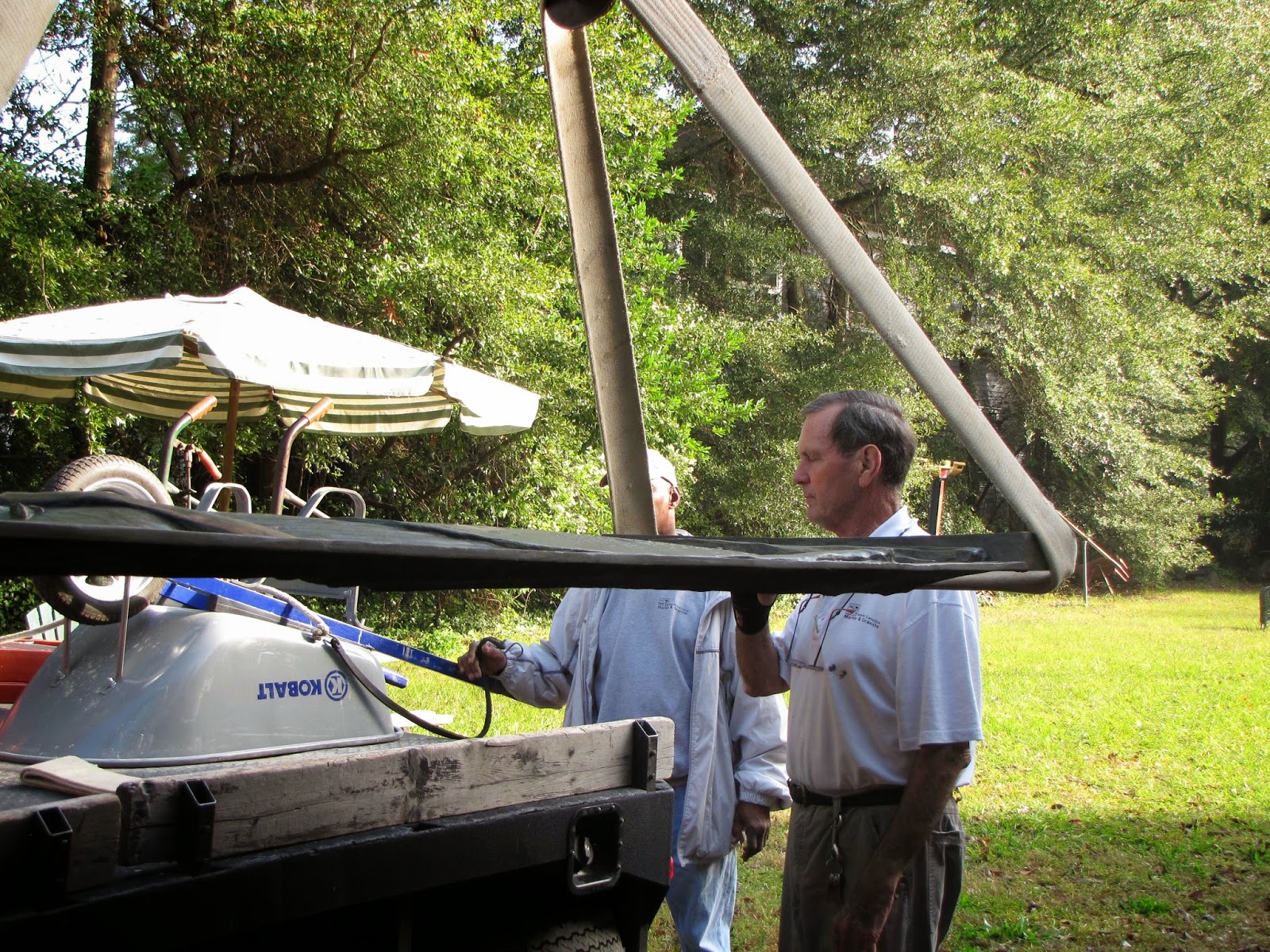
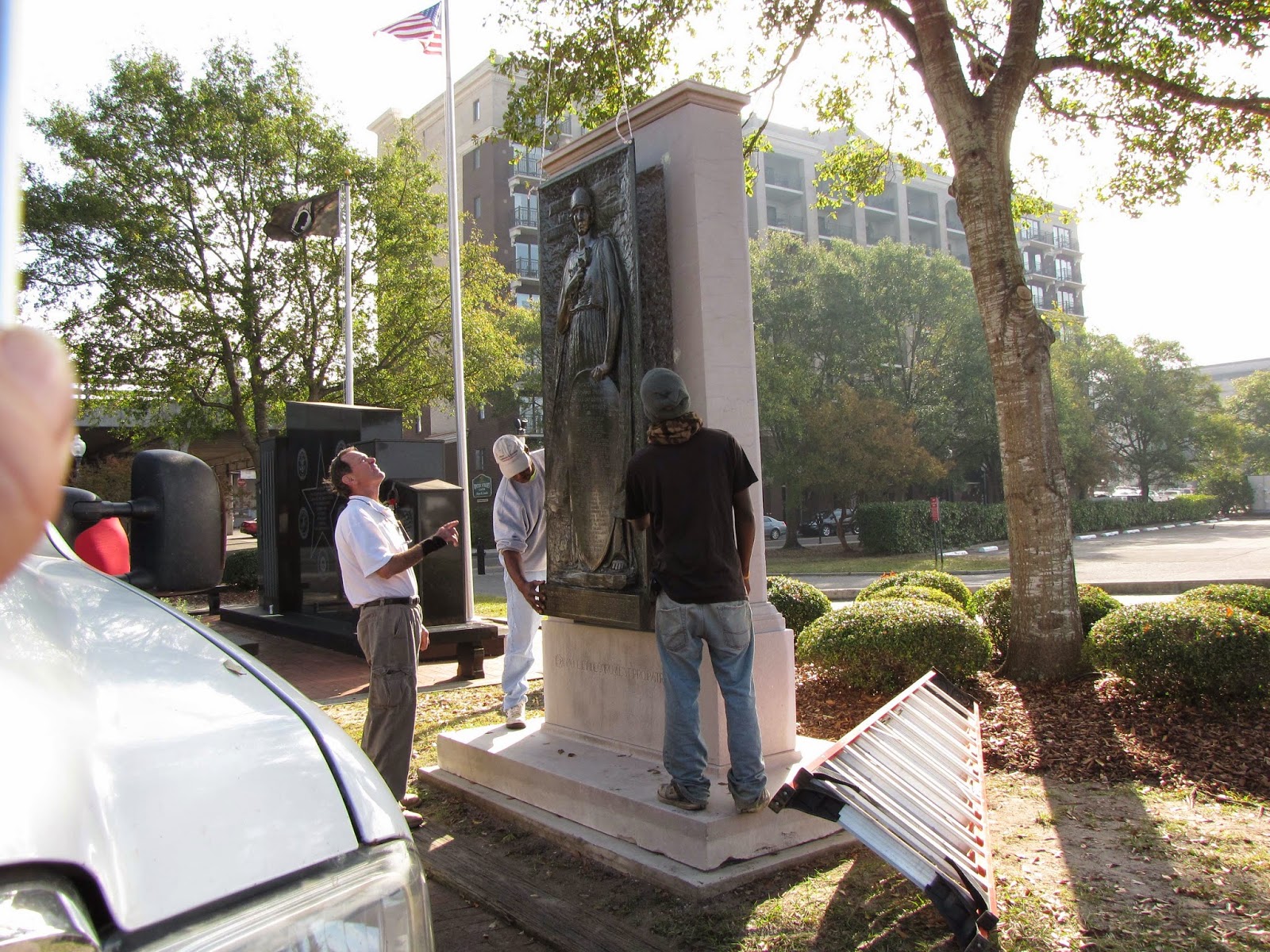
The North Carolina Marble and Granite Company team worked to attach the bas-relief to the marble.  It was rather like hanging a shelf, except the bas-relief needed a crane to lift it into place.
 
 
Workers lined up the bas-relief.


Making sure everything lines up


They marked where the new holes needed to be drilled.


Then they removed the bas-relief so they could safely re-drill the holes.


The contractors fabricated new bolts to attach the bas-relief to the base.  The one on the left is the 21st century version.


Then they swung the bas-relief back into place and attached it to the memorial once more.


Sunday, November 9, 2014

Moving the Memorial, part 1


In the Spring, amid some controversy, the decision was made to try to move the memorial.

City, county, and school board officials have worked together and the Memorial will be rededicated on November 11, 2014.
 
In the Fall, the memorial began to move...you can see a video of it being removed from the high school's grounds:


Outside New Hanover High, September 25, 2014


The marble part of the Memorial was cleaned and moved down to the Wilmington Riverfront by North Carolina Marble and Granite Company


The monument on the Wilmington Riverwalk, September 2014


Work on the brass bas-relief  was performed by Wilmington artist Dumay Gorham, III. 

Visiting Dumay Gorham's studio, at Acme Art
 
close-up of the top of the bas-relief after some work has been performed


clasping laurels
 
 
*********************
 

Saturday, November 8, 2014

After the Dedication, 1923 to March, 2014


Memorial, 1926


The memorial has seen some action over the years. In January 1923, the monument was “hurled from its base”when it was hit by a car belonging to Colonel Walker Taylor.


The damage was very substantial – it took months to repair because the “main upright stone, which was broken almost in half by the impact of the skidding autombile, has been replaced with a new one.  Little damage was done any other part of the monument.”

This isn't the only time a car has collided with it -- it was also struck by a “careless automobile driver” in December, 1936.

The memorial has also been cleaned, notably in 1932 when the newspaper reported the monument was “completely cleansed and put in good condition through the country of the Carolina Cut-Stone Company, of this city.The stone was badly defaced by pencil marks and other bits of vandalism, and on the suggestion of the ladies’ auxiliary of the American Legion here, the Carolina Cut-Stone company effaced such marks. They declined to accept payment for the work. All children and especially high school pupils are asked to abstain from marking this Monument.”

Still, for the most part,  the memorial stood in the median on Market Street, pretty much as it was, for more than fifty years.


 Then, in the 1970s, the War Memorial was moved in front of the school. 

It was reported in February 15, 1973’s newspaper that “two monuments from the plaza in front of New Hanover High School” were removed after the city’s planning commission approved an overhead ramp earlier in the month. One of those two monuments was the World War I memorial.

The overhead ramp, 2014
 

And, until 2014, that's where the monument stayed. 

Then in the Spring of 2014, a group of Wilmingtonians met to talk about moving, cleaning, and restoring the Memorial.


Friday, November 7, 2014

Dying "Over There"


As my last post shows, a number of the men on New Hanover County's memorial died before they got to the battlefields.  Other casualties of war died on foreign soil.


Sheet music, 1917
CFM 1997.088.0093
Gift of Suzanne Sheetz


Although the U.S. entered the war in April of 1917, it took some time before large numbers of troops were sent overseas, and even then, they did not immediately fight.  The first U.S. casualties in the war occured in November, 1917.  Most of America's fighting men were not involved in combat until the last months of the war.  This is reflected in the death dates of the local men who were killed in action.  
 
Douglas W. Pate died of wounds he received during the war, but it is not clear when or where he died, or what branch of the services he was involved with. Pate was born January 10, 1895 in Robeson county. He was living in Wilmington when he registered for the draft on June 5, 1917.  It seems likely that he died between July and November of 1918.
 
CFM 1998.119.0011
Gift of Hugh MacRae, III

Lieutenant David Worth Loring died in Belgium on August 24, 1918. When he registered for the draft, Loring was living at 308 N. Front Street. He worked for the railroad. When the Wilmington Morning Star Reported Lieutenant Loring’s death on September 17, 1918, the article said he died of “wounds received in action.” According to the paper, David was initially declared physically unfit for duty, and he had an operation so that he could serve.
Loring was married to Viola Shaw Loring.  The couple wed in April of 1916.  The Lorings had a baby boy who lived 15 hours in January 1917. So in the span of two years, Viola Loring lost a son and a husband.
Lieutenant Loring was awarded the Distinguished Service Cross.  He is buried in Flanders Field American cemetery.


The Heart of America, 1918
CFM 1963.002.0029
Gift of General John Van Bokkellen Metts, Jr.


Corporal Bennie King died on September 29, 1918. He served in the U.S. Army 119thInfantry Regiment, 30thInfantry Division. He is listed on the tablets of the missing at Somme American Cemetery.


The Winners of the Marne, 1918
CFM 1963.002.0016
Gift of General John Van Bokkellen Metts, Jr.
 

Private Vaughan E. Smith served overseas from May 9, 1918 to Sept 29, 1918 when he was killed in action. Smith enlisted in New York on May 23, 1917. His father, Robert E. Smith, lived in Wilmington, and so that seems to be why he is on the New Hanover County memorial. Smith served in the U.S. Army 107th Infantry Regiment, 27th Division. He is buried at the Somme American Cemetery, Bony, France


To the Beautiful Land of France, 1918
CFM 1963.002.0030
Gift of General John Van Bokkellen Metts, Jr.

Private William M. Turner died on October 15, 1918. He served with the army's 167th Infantry Regiment, 42nd Division. He is buried in the Meuse-Argonne American Cemetery, Romagne, France.
Theodore S. Sidbury died Oct 17, 1918 in France.  He was killed in action.  Sidbury volunteered with a Company C, a locally organized cavalry unit that became a machine gun unit.  Before the war, he was a tinner.  He is buried in in Westbrook Shepard Cemetery Sloop Point, in Pender County.  He was 21 when he died.

CFM 1997.060.0029


Captain Joseph J. Loughlin died on 9 Nov 1918. He is buried in St. Mihiel American Cemetery, Thiaucourt, France. Loughlin served in the 322nd Infantry Regiment, 81st Infantry Division. Josepth was married to Eleanor King Loughlin. The couple had three children. Two of Loughlin's children helped dedicate the World War I memorial in 1922. 

Private Walter S. Brock of Seagate was killed in action on November 10, 1918. He was born 13 Sep 1885. He is buried at Mount Lebanon Chapel cemetery, at Airlie

Private Brock had the misfortune to die just one day before the war ended.

The War officially ended on Nocember 11, at 11A.M, Paris time

Colin Makepeace MacRae was even unluckier.  He died on January 30, 1919, when he was lost overboard at sea from the U.S.S. South Dakota. MacRae was still in his teens. Colin's brother, Marion, also served in the First World War.
 

 **************