On Memorial Day, May 30, 1922, a World War I monument was
unveiled in front of New Hanover High School, at Market and South Thirteenth
Streets.
A Group Forms: December 1918
A group of local white men and women began to plan for a war
memorial less than one month after the First World War ended. On Dec 5, 1918, the Wilmington Dispatch reported that a chamber of commerce committee had
been formed to plan a memorial. Initial reports suggested that the committee wanted to raised $25,000 and put
the monument on Market between Front and Second streets.
 |
CFM 1983.003.0010
The First World War took place in an era of post Civil War
"reconciliation." The idea that both Confederate and U.S. soldiers
were brave was promoted as a way to create national unity. |
The male committee consisted of E. T. Taylor,
T. E. Cooper, Dr. John J. Hurt, C. C. Chadbourn, Woddus
Cellum, W. H. Sprunt, J. A. Taylor, George H. Hutaff, L. W. Davis, Roger Moore
and James H. Cowan.
A committee of women were appointed to “assist” the men. The women represented “each of the ladies’ organizations of the city.” The women listed were: Mrs. W. L.
Parsley, Mrs. W. B. Cooper, Mrs. Cuthbert Martin. Mrs. S. Solomon, Mrs. W. P. Sprunt,
Mrs. J. M. Solky, Mrs. E. K. Bryan, Mrs. William Latimer, Mrs. John R. Hanby,
Mrs. R. W. Hicks, and Misses Jennie Wood and Margaret Corbett.
The committee quickly concluded that they would raise the
money by popular subscription and set the goal of Robert E. Lee's birthday, presumably Lee's birthday in January of 1919, for raising the cash.
Wilmington's memorial was to be built by private subscriptions in honor of
those "who laid down their lives on the battlefield of France."
It took longer than the committee hoped to raise the money for the monument. And the committee downsized their expectation of how much they would raise: By June of 1919,
the committee had secured promises for approximately $7,000, a lot less than the initial figure of $25,000. In the end, the monument seems to have cost $6,000. Right before the monument was dedicated the
paper said, “The momument is the gift of the entire populace of the city and
will cost when unveiled only $6,000. No
efforts to secure large contributions were made, the desire being that all
people should participate in its erection.”
A Monument is Made:
The monument was made in Baltimore Maryland. Joseph Maxwell Miller sculpted the bronze bas relief tablet.
 |
| Memorial, before cleaning, 2014 |
Miller also sculpted Maryland’s Confederate Women’s Monument (1917).
For the Wilmington project, the J. Arthur Limerick Company (also from Baltimore, Maryland) cast the bronze, and W. Gordon Beecher was the architect .
Beecher and Miller also collaborated on the Prince George’s County Maryland World War I monument which was erected in 1919.
A Location is Chosen: 1919-1922
It wasn't clear where the monument would be placed in Wilmington. Even though in June 1919, the paper stated “The site and
design of the monument will be made in the early fall and will be fraught with
much care to appropriately perpetuate the memory of Wilmington soldiers who
gave their all in the great war.”
It was actually three years later that the final decision was made.
By 1921, it seemed that the city council had
agreed to put the monument on Market Street in principle, but “at what point on
Market Street the monument will be erected remains to be decided…”
 |
| Postcard, from about 1919, CFM 1999.114.0042 |
Finally, just one month before the memorial was dedicated, in April of 1922, the
Memorial committee’s location committee met and chose a site.
The committee decided to ask the city for
permission “…to erect the memorial to the city and county’s soldier dead on the
plaza in front of the high school on Market street….”
And that’s where it ended up: “…on the east plaza of Market Street, in front of
the New Hanover high school building.”
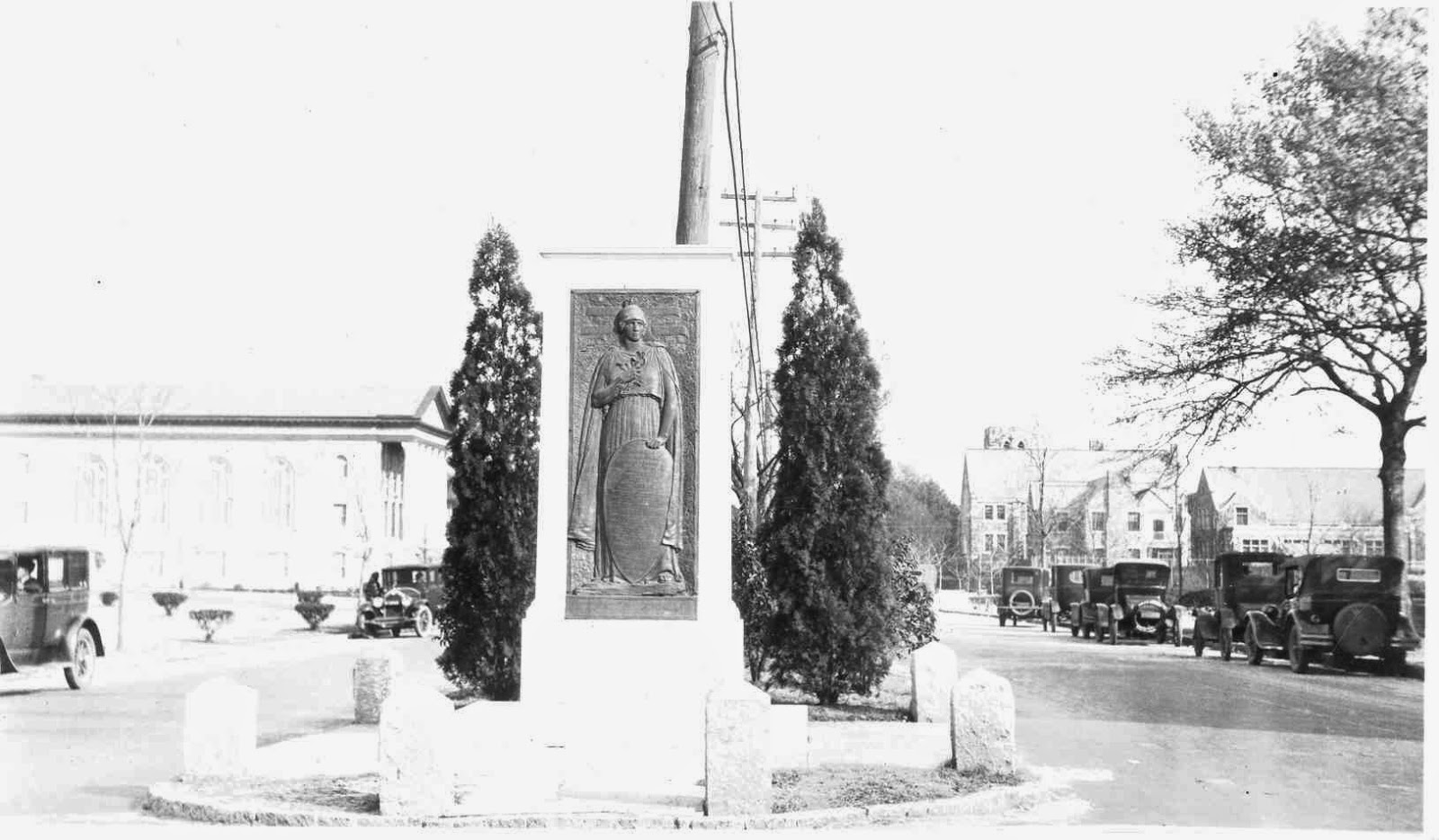 |
World War I memorial, February, 1926
CFM 1985.017.0001 |
 |
Image of New Hanover High, about 1925, with war memorial in middle of Market Street
CFM 2001.069.0002, Museum purchase |


.jpg)


