Pages

Monday, November 3, 2014

More men at Oakdale


Thomas B Carroll


Thomas B. Carroll was a physician in the U.S. army.  He died of apoplexy on Nov 10, 1918.  His daughter, Helen Marie Carroll was one of the four children who unveiled Wilmington's World War I memorial in 1922.  She was eleven at the time.
 
 Warren Gregory Davis


Warren Gregory Davis was born in 1894 and died in Verdun, France.  Like Arthur Bluethenthal, Davis was first buried in France, then his remains were returned to Wilmington.   The Wilmington Dispatch of June 17, 1921 noted the “Remains of Lieut. Warren Gregory Davis, killed in France two days before the armistice was signed, will arrive in the city Sunday morning at 9:45 o’clock from New York, where they were recently brought from overseas, and the funeral will be held late Sunday afternoon.”

James S. Glass


James S. Glass was born in England in 1890.  When he registered fro the draft, he lived in Wilmington on Grace Street and was a clerk with the Atlantic Coastline Railroad.  He died February 8, 1919 in France.   


John Victor Grainger, Jr.


John Victor Grainger,Jr.,  died at Camp Gordon, in Atlanta, Georgia.  He was born in January 8, 1889. He married Helen Kenly  in May of 1912, and the couple had a daughter, Priscilla, in 1916.  According to the paper, Grainger was “a man of sterling character and pleasing personality and was universally well liked.”   He a graduate of Princeton University, and worked at the Murchison bank.  Grainger died while he was at officer training school at Camp Gordon. He became sick with influenza and passed away on October 9, 1918.  
 
James Craig Loder


Lieutenant James Craig Loder died on July 18, 1918 in France.


Cardon Othneil Perry


Corporal Cardon OthNeil Perry was born on September 14, 1893.  In 1917, he was a baggage master with the Seaboard Airline Railroad. He died in France, during the Somme Offensive, on October 17, 1918.


Cardon Perry's memorial certificate
CFM 1992.18.0002
Gift of Mark Wilde-Ramsing


Cardon O. Perry, "Dead for liberty" memorial
CFM 1992.018.0003
Gift of Mark Wilde-Ramsing

Harry Faison Shaw


Harry Faison Shaw died on December 21, 1918.  Shaw was born in Brunswick county, and served in the U.S. Navy.  He died in New York City.


Frank Lenox Williams


Frank Lenox Williams was a first Lieutenant with the 119th infantry regiment of the 30th division of the U.S. Army.  He died in France, on October 18, 1918.
 
Frank Lenox Williams picture left, about 1915
CFM 1980.045.0109
 
 
Frank Lenox Williams' widow, Fan Lamb Williams with Frank Lenox Williams, Jr. 1919
CFM 1980.045.0092
Gift of Henry Jay MacMillan


Frank's son, Frank Lenox Williams, Jr., was born on November 11, 1918, the day the war ended, and just weeks after his father was killed in France.  He was one of the children who unveiled the county's World War I memorial in 1922. 

 
**************


Saturday, November 1, 2014

Some of the Men on the Monument -- Oakdale


Eleven on the fallen are buried at Oakdale Cemetery, in Wilmington. 


Thomas F. Bagley, Jr.'s gravestone, Oakdale Cemetery


Thomas F. Bagley, Jr. died on February 23, 1918 in New Hanover County. He was a soldier in the U.S. army and died of accidental asphyxiation by gas.  His tombstone states he was a corporal in the 8th Company, Cape Fear Coastal Artillery, at Fort Caswell.


Fort Caswell, about 1918
CFM 1980.045.0064
Gift of Henry Jay MacMillan


Jasper Best's grave, Oakdale Cemetery
 
Jasper Leon Best  was born in 1888, and died in SC in December 21, 1917.   He died at Camp Sevier. Best was a private in the 119th infantry's company B.   Before the war, Best worked for the Atlantic Coastline Railroad as a car repairman.  The paper announced that he died of “pneumonia following measles.”


Arthur Bluethenthal was the first Wilmingtonian to die in combat in World War I.

Arthur was born in Wilmington in 1891.  He attended the prestigious Philips Exeter Academy between 1907 and 1909. In 1913, Arthur graduated from Princeton University, where he had been a football star. After graduating, Bluethenthal went to work for his father’s business, and coached football at the University of North Carolina at Chapel Hill and at his alma mater, Princeton.


In 1916, after World War had raged in Europe for two years, Arthur joined the American Field Service in France where he became a member of the ambulance service.


Arthur (far left) playing cards in the Ambulance Corps, 1916
CFM 1990.066.0015


He later joined the French Foreign Legion and became an aviator. His plane was shot down near Maignelay, about fifty miles north of Paris, on June 5, 1918. Arthur was a decorated war hero before his death, and the French government posthumously awarded him the Croix de Guerre with Palm on June 9, 1918.

 Bluethenthal was first buried in Europe.


In the early 1920s, his body was reinterred at Wilmington’s Oakdale Cemetery.


Arthur Bluethenthal's grave, Oakdale Cemetery


************


Friday, October 31, 2014

Wilmington's African American dead


Three African Americans were killed in World War I. Their names were placed on the bottom of the Memorial, separated from the white men who lost their lives in the War. 

During World War I, the U.S. Armed forces were segregated.  Wilmington's memorial reflects that division even in death.  Although many African American men enlisted in the armed services, and many were conscripted after the draft, few saw actual combat.  Reflecting the tenor of the times, most of the 350,000 African Americans in the armed forces worked in supporting roles.  


Thomas Bullock


Image courtesy of State Archives of North Carolina


That wasn't the case for Thomas J. Bullock, the first name on the "colored" section of Wilmington's memorial.  (The memorial erroneously lists Lieutentant Bullock as Thomas S.)  


Thomas Bullock was a member of what W. E. B. DuBois called the "Talented Tenth" -- he graduated from Lincoln University, and was a principal at Wilmington's Williston Industrial School.   In June, 1917, Bullock went to an African-American only  officer training school in Iowa.  Afterwards he was sent to Camp Upton in New York in the Fall of 1917. 


Camp Upton, New York, 1919
Courtesy of Library of Congress

Bullock died in France, on September 2, 1918,  after fighting around Frappelle.  He was a part of 367th infantry unit of the 92nd Divison, and was, according to Emmett J. Scott's book, the first officer to die in combat.  (In contrast to other sources, Scott's work seems to suggest Bullock died on August 31.)
After the War, the local African American American legion post was organized and named after Lieutentant Bullock. 


Cape Fear Museum image archive

June 5, 1921, The Wilmington Dispatch noted that  “The remains of Lieut Thomas J. Bullock, of Wilmington, killed in the second battle of the Marne, arrived from France and services in his honor were conducted at St. Stephen’s A.M.E.  Church. The remains were re-interred in Pine Forest Cemetery.   He entered officer’s training camp soon after United States entered the war and was commisioned second lieutenant.  He gallantly fought in many engagements in France."
Two other African American men were also on the Memorial.

Simon Taft Shiver


On April 29, 1918, Simon Taft Shiver was inducted into military service. On April 30, Shiver was send to Camp Jackson. SC. along with 27 other men. On May 12, 1918, Shiver died at Camp Jackson in Columbia South Carolina. He was a private in Company 12, 186 Depot Brigade. He was listed as a school teacher; his father was the Reverend S. T. Shiver.


Cover of The Crisis, NAACP's magazine
accessed at http://www.modjourn.org/render.php?id=1292951205264875&view=mjp_object
 
Edward Peden
No records could be found relating to an Edward Peden.  A “Negro” Edward Franklin Peeden was registered for the draft on June 5, 1917.  He was listed as born on Sept 10 1896.  He was a hotel waiter at the Wilmington Hotel.  And an Edward Peeden was living in Wilmington in 1910, aged 13, with his family in the Delgado neighborhood.  But it is not clear where or when Edward died.

This World War I era poster was recently donated to the Museum


Thursday, October 30, 2014

Dedicating a Memorial, 1922, part 2

May 30, Memorial Day, 1922

In 1922,  the World War I memorial was dedicated.

A local paper, the Wilmington Dispatch declared there were speeches from a “flag draped speakers’ stand that had been erected in the intersection of Market and Thirteenth streets, just prior to the firing of a salute over the handsome monument that contains the names of the country’s [sic] world war heroes who fell in the line of duty…”

The Morning Star declared the monument was unveiled by “four little children, Paul Elliot Loughlin, Eleanor Loughlin, Helen Carroll, and Frank Williams, whose parents lost their lives during the war.”

This picture was taken after the unveiling. 

detail from panoramic image, May 30, 1922
CFM 2007.041.0017


left side of panorama, 1922


right side of panorama, 1922


Although you can't see a flag-draped podium in the image, it's pretty easy to imagine someone giving a talk right in front of the monument.  And, in fact, we know who spoke at the event from reports in the local newspapers.


Robert C. Cantwell, II on the far left, in 1922
CFM 2007.041.0015


American Legion Post Commander R. C. Cantwell, II
presided over the occasion.  The picture to the left shows him dressed in colonial garb for a pageant performance from about the time the Memorial was dedicated. 


At the ceremony, Mississippi's senior Senator Pat Harrison gave the oration. 

Senator Harrison's oratory reminds us that the Civil War was still very much in the forefront of white southerners' thinking.  Even though he was speaking at a memorial honoring the service of white and black Americans who fought in a war on European soil, his rhetoric evoked a vision of an occupied south. He declared “Your skies have been clouded with the smoke of battle, your land ravished by invading forces, and your streams have run red with the blood of your sons and fathers, but you have born yourselves as true sons of the south and Americans in every emergency.”


Local minister Reverend W. W. Morton gave an invocation and he read out the names of the dead who “fell in the conflict overseas or in the line of duty…”

poppies picked at Flanders field, 1921
CFM 1962.081.0001


Thirty seven men's names were on the memorial:


As you can see from the picture, the memorial segregated African Americans and whites even in death. 


Arthur Bluethenthal's grave in France
CFM 1990.066.0054
 

The list of the dead on the memorial includes men like Thomas J. Bullock, Arthur Bluethenthal, Warren Gregory Davis, and David Worth Loring who died in Europe.  And it includes men like Simon Taft Shiver, Archie Melton, and Joseph F. Holland who died of disease in the United States. 


Edward T. Taylor, chairman of the citizens committee officially presented the monument to Addison Hewlett, chairman of the board of county commissioners.

When E. T. Taylor presented the memorial to the county he reportedly said “May 30th has been set aside by the American Legion as a day sacred to the memory of their deceased brothers in arms, who lost their lives in our behalf in the world war. It is fitting therefore, that on this day we gather to pay our respects to the memory of the dead and to inspire by our example veneration for these heroes in the lives of the children today and of future generations.”

Before the “Great War” Memorial Day was mostly celebrated in the North (because it grew out of the Civil War). After World War I, Memorial Day was expanded so it honored veterans of all wars, making the day more palatable to pro-Confederate southerners. 

Although 37 New Hanover County men are on the Memorial, many more local residents served in World War I.


Army Nurse Rachel Loman's medal
CFM 2007.020.0007
Alfred Sternberger's North Carolina World War I service medal
CFM 1975.041.0005
E. Fleet Williams'
"Great War for Civilization" medal
CFM 1966.031.0002
 
At the dedication. E.T. Taylor’s speech continued: “The citizens of Wilmington and New Hanover county, prompted by the desire to express their undying love and affection for those who gave their all for them, acting under the auspices of the chamber of commerce, rasied a fund by public subscription from all sources—merchants, manufacturers, bankers, farmers, laborers and school children—for the erection of a monument which would perpetuate the nawes of each of the boys who made the supreme sacrifice. This work of love has been accomplished; the monument bearing the names of our dead heroes now stands before you and is ready to be presented. It has been erected at this spot in the hope and belief that it will be a constant inspiration to the school children of the counry to make their lives worthy of these heroic dead…”

 
The then-segregated New Hanover High School was the only high school for white children in the city when the Memorial was dedicated. 


Tuesday, October 28, 2014

Memorializing World War I, part 1


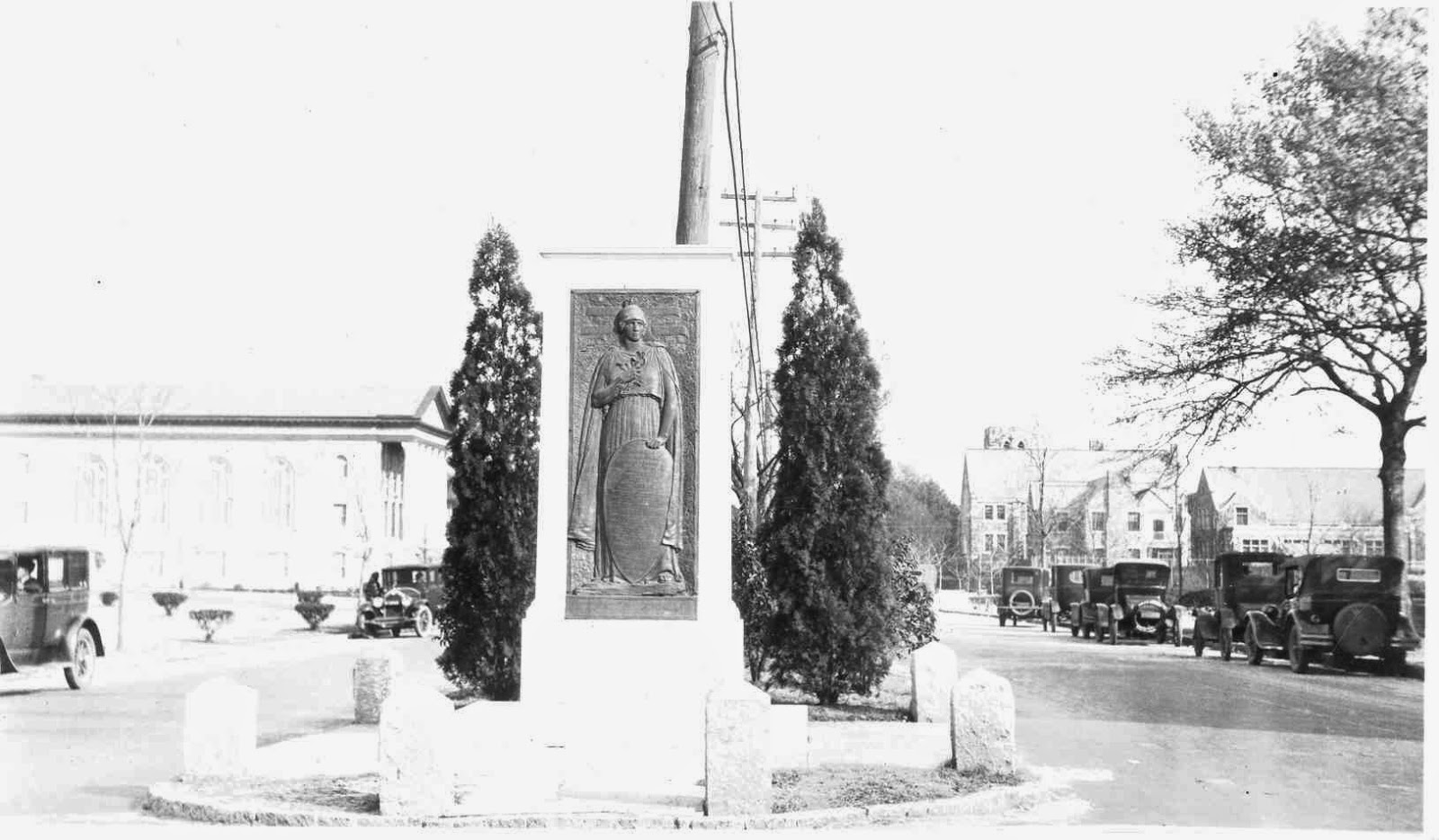
On Memorial Day, May 30, 1922, a World War I monument was unveiled in front of New Hanover High School, at Market and South Thirteenth Streets.
A Group Forms:  December 1918

A group of local white men and women began to plan for a war memorial less than one month after the First World War ended.  On Dec 5, 1918, the Wilmington Dispatch reported that a chamber of commerce committee had been formed to plan a memorial.  Initial reports suggested that the committee wanted to raised $25,000 and put the monument on Market between Front and Second streets.


CFM 1983.003.0010
The First World War took place in an era of post Civil War
"reconciliation." The idea that both Confederate and U.S. soldiers
were brave was promoted as a way to create national unity.

The male committee consisted of  E. T. Taylor, T. E. Cooper, Dr. John J. Hurt, C. C. Chadbourn, Woddus Cellum, W. H. Sprunt, J. A. Taylor, George H. Hutaff, L. W. Davis, Roger Moore and James H. Cowan. A committee of women were appointed to “assist” the men.  The women represented “each of the ladies’ organizations of the city.”  The women listed were: Mrs. W. L. Parsley, Mrs. W. B. Cooper, Mrs. Cuthbert Martin. Mrs. S. Solomon, Mrs. W. P. Sprunt, Mrs. J. M. Solky, Mrs. E. K. Bryan, Mrs. William Latimer, Mrs. John R. Hanby, Mrs. R. W. Hicks, and Misses Jennie Wood and Margaret Corbett.


The committee quickly concluded that they would raise the money by popular subscription and set the goal of Robert E. Lee's birthday, presumably Lee's birthday in January of 1919, for raising the cash.


Wilmington's memorial was to be built by private subscriptions in honor of those "who laid down their lives on the battlefield of France."


http://www.capefearmuseum.com/collections/wartime-telegram-june-19-1918/
Wilmingtonian Arthur Bluethenthal died in World War I
CFM 1990.066.0022
It took longer than the committee hoped to raise the money for the monument.  And the committee downsized their expectation of how much they would raise:  By June of 1919, the committee had secured promises for approximately $7,000, a lot less than the initial figure of $25,000.  In the end, the monument seems to have cost $6,000.  Right before the monument was dedicated the paper said, “The momument is the gift of the entire populace of the city and will cost when unveiled only $6,000.  No efforts to secure large contributions were made, the desire being that all people should participate in its erection.”

A Monument is Made:  
 
The monument was made in Baltimore Maryland. Joseph Maxwell Miller sculpted the bronze bas relief tablet. 

 
Memorial, before cleaning, 2014


Miller also sculpted Maryland’s Confederate Women’s Monument (1917).

For the Wilmington project, the J. Arthur Limerick Company (also from Baltimore, Maryland) cast the bronze, and W. Gordon Beecher was the architect .


Beecher and Miller also collaborated on the Prince George’s County Maryland World War I monument which was erected in 1919.


Prince George's County war memorial, found on
 http://dcmemorials.com/index_indiv0002991.htm
 
 
 A Location is Chosen: 1919-1922

 
It wasn't clear where the monument would be placed in Wilmington.  Even though in June 1919, the paper stated “The site and design of the monument will be made in the early fall and will be fraught with much care to appropriately perpetuate the memory of Wilmington soldiers who gave their all in the great war.” It was actually three years later that the final decision was made. 

By 1921, it seemed that the city council had agreed to put the monument on Market Street in principle, but “at what point on Market Street the monument will be erected remains to be decided…”

 
Postcard, from about 1919, CFM 1999.114.0042


Finally, just one month before the memorial was dedicated, in April of 1922, the Memorial committee’s location committee met and chose a site.

The committee decided to ask the city for permission “…to erect the memorial to the city and county’s soldier dead on the plaza in front of the high school on Market street….”

And that’s where it ended up: “…on the east plaza of Market Street, in front of the New Hanover high school building.”
 
http://www.capefearmuseum.com/collections/world-war-i-memorial-february-1-1926/
World War I memorial, February, 1926
CFM 1985.017.0001


Image of New Hanover High, about 1925, with war memorial in middle of Market Street
CFM 2001.069.0002, Museum purchase


Saturday, March 8, 2014

The Flag tells its own story


Examining the flag as an artifact would seem to contradict Louis Toomer Moore’s conclusion that this flag was at a meeting on February 1, 1861. 

Counting Stars

The official U.S. flag had 33 stars when South Carolina seceded from the United States on December 20, 1860.  

On February 8, 1861, six states signed a provisional constitution for the Confederate States of America, and by February 18, 1861 Jefferson Davis was President of the Confederate States of America.  By the time the Confederate States created a flag, a seventh state had joined the confederacy, so the flag had seven stars, one to represent each state.

National flag of the Southern Confederacy; Detail from Frank Leslie's Illustrated Newspaper, March 30, 1861, p. 292

The stars for those 7 states remained on the U.S. flag, reflecting the Union position that states could not secede.

And yet, Cape Fear Museum's U.S. flag has 34 stars.

On January 29, 1861, Kansas became the 34th state of the Union. The Wilmington Daily Herald noted on that day that the Senate had passed the Kansas Bill and reported two days later, on January 31, that the president signed it.

So the Union was made up of 34 states on February 1, 1861.  But the 34 star flag became the official U.S. flag on July 4, 1861, months after North Carolina seceded from the Union.  (It remained the official flag until July 4, 1863, until West Virginia became a state.)
It therefore seems unlikely (although I guess technically possible) that Mr. Covell would have had a 34 star flag for sale in his store on February 1, 1861, the day after Kansas became a state.  

And our flag's construction suggest that even if it were feasible to add a star to an existing flag over night, our flag was not modified.  The the position of the stars on the flag as well as the condition of the material of the stars suggest that they were all made and attached at the same time.   The fact that the row with 6 stars are evenly spaced, and so are the other rows seems to provide additional proof that they were all sewn on at the same time.  The state of the color and fabric of the stars does as well.


That said, since the CFM flag is handmade, it could easily have been produced between January 29th and April/May when it seems Covell left Wilmington.  And even though the flag was not official until months after North Carolina succeeded from the United States, 34 star flags did fly before that official date. 

Still, there was no mention of Covell or his flag in the two local papers, so it cannot be independently placed in town. 

And, as the 34 star flag was the flag of the U.S. until July 4, 1863, it is technically possible (albeit rather unlikely) that Covell purchased the flag in Rhode Island and misremembered having it with him in North Carolina.  

Even though it is not possible to definitively confirm that Covell flag was in Wilmington in the run up to North Carolina’s exit from the United States, the circumstantial evidence seems to strongly suggest that it was.  

There is no obvious reason that Mr. Covell would have made up the story – a Northern Civil War era U.S. flag surely would have been as valuable a family memento to a Rhode Island merchant as one with a Southern history.  (Although as a counter argument, maybe it makes a more exciting family story to have him spiriting the flag off north….)    

Much of the circumstantial evidence fits the family lore– William K. Covell, Jr. was a ship’s chandler, and flags were very much a part of the maritime world so he would have had flags at his shop, or had access to a flag maker who could provide them to him. Newspaper accounts show pro Union members of the community did fly U.S. flags at meetings, so it seems reasonable that someone could have asked Covell to bring one to a meeting. 

By the time he left Wilmington, flags were freighted with symbolic meaning on both sides of the divide.  These sheet music covers give you a sense of  how flags had become to mean more than the sum of their stitches. (and you can look at my older blog for more on that, too....Civil War Redux). 

Courtesy of Library of Congress


Image of sheet music courtesy of the David M. Rubenstein Rare Book & Manuscript Library, Duke University

 And since William K. Covell identified with the North, he would likely have taken a flag back North to “protect” it from the Secessionists.  

Taking all this together, it’s not hard to believe that this flag was in Wilmington in the Spring of 1861, and that perhaps it made an appearance at an election rally as the vote for secession (end of February, 1861) was taking place.  Perhaps it came out at a later meeting to discuss the Peace Conference (early March).  Or perhaps it was just a part of Covell’s shop stock.  In the absence of definitive evidence, we will never really know.